
DDCS – Dynamic Drone Capture System

DDCS – Dynamic Drone Capture System_(German version)
Controlled Non-Lethal Counter-UAS Technology
Strategic intellectual property portfolio for controlled drone neutralization in critical infrastructure, airports, and sensitive airspace
Challenge:
Modern counter-UAS systems are becoming increasingly reliable at detecting, classifying, and tracking drones. However, the critical operational gap remains in the controlled resolution of a drone incident.
Especially in airport environments, critical infrastructure areas, industrial facilities, government sites, and urban security zones, traditional defense methods are only of limited use. Jamming, spoofing, lasers, microwaves, kinetic effectors, or interceptor drones can create new risks: uncontrolled crashes, fragmentation, electromagnetic interference, additional flying objects in the danger zone, liability issues, or prolonged shutdown periods.
In these operational areas, it is not enough to simply neutralize a drone “somehow.” It is crucial that the threat situation be resolved without the defensive measure triggering a secondary incident.
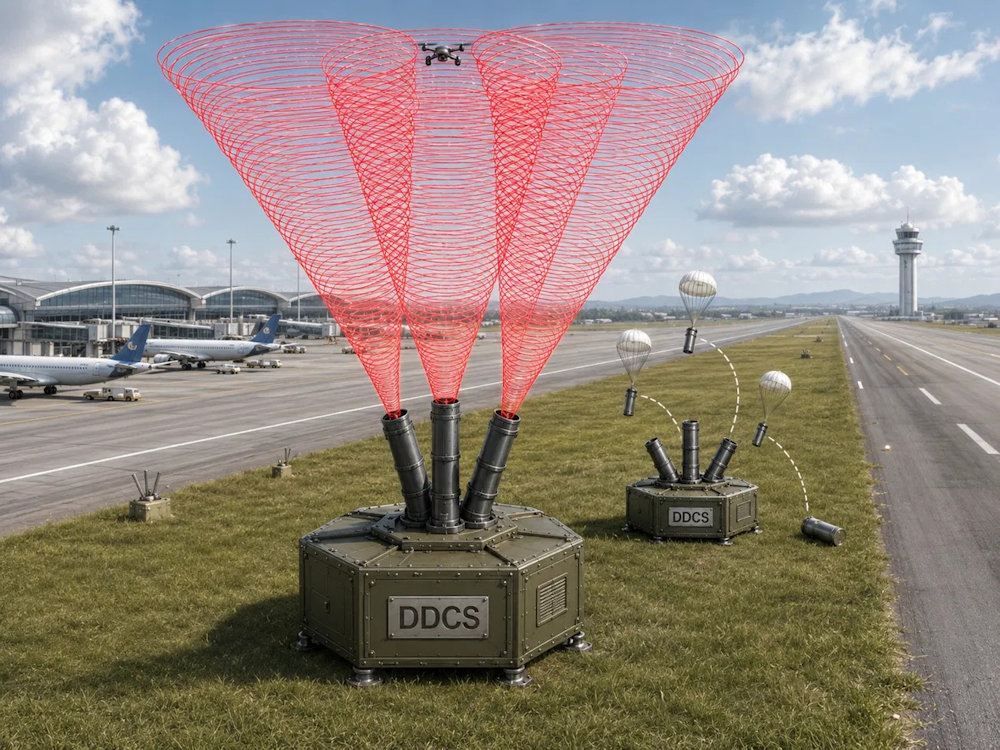
Controlled, non-lethal drone neutralization
Physical mechanism of action without conventional destruction
No fragmentation of the target drone as the primary operational effect
No additional pursuit or interceptor drones in the danger zone
No primary radio or GNSS jamming
Preservation of the drone for forensic analysis
Modular and scalable system architecture
Integration into existing sensor, control center, and C2 infrastructures
Potential for rapid clearance of affected areas
This difference is particularly significant at airports. There, it is not only the drone itself but, above all, closures, diversions, security checks, operational disruptions, and secondary risks that cause considerable damage. DDCS aims to bring a drone incident under control and quickly restore the affected area to a state where it can be reopened.
Why the Scope of Operation Is Strategically Relevant:
DDCS addresses not just a single technical implementation, but a scope of operation and solution—for which intellectual property rights have been filed—within the field of controlled, non-lethal drone defense.
The strategic core lies in a physical field of action that is controlled and directed against the drone. This approach is of central importance, particularly at airports, critical infrastructure sites, and in sensitive airspaces: In these locations, firearms, lasers, destructive effectors, or additional projectiles are regularly associated with significant operational, safety, and liability risks.
If a drone is not to be destroyed, fragmented, subjected to uncontrolled electronic interference, or pursued by a second projectile within the danger zone, the only operational option remaining is a controllable physical field of action that is directed against the drone.
DDCS addresses precisely this solution space.
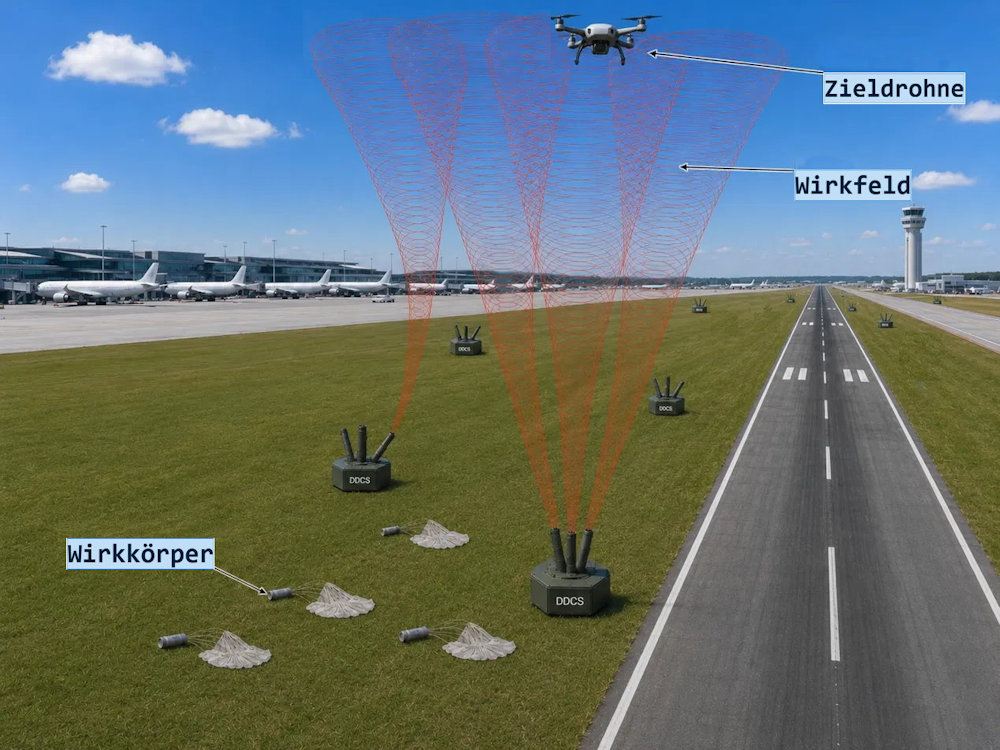
Scalable Field Geometries and Swarm Defense:
A key strategic advantage of DDCS lies in its ability to dynamically generate physical field geometries. The system is not limited to a single capture configuration but can establish various dynamic operational areas depending on the threat situation—ranging from localized capture zones to corridors, funnels, fans, and walls, all the way to large-scale, overlapping protection zones.
This makes DDCS fundamentally relevant for swarm scenarios as well. Multiple effect modules can be combined to form a larger physical operational space that addresses not only a single drone but also multiple systems flying in simultaneously. The size, density, and arrangement of the deployed effect field are crucial in this context.
Particularly with drone swarms, the operational advantage arises not from tracking individual targets, but from the controlled establishment of a physical exclusion and capture zone. DDCS can thus create a dynamic operational area that counters the threat and is scalable over a large area.
Time and Development Advantage:
DDCS offers an industrial partner not only access to a novel operating principle, but also a significant time advantage.
There is no longer a need to conduct a fundamental search for, evaluate, and secure intellectual property rights for the relevant solution space. The technical operating logic, system architecture, sensor and target tracking integration, modular capture logic, and scalable array structure are already available as an engineering-ready concept.
This allows a buyer to significantly shorten the development process. Instead of first investing several years in its own concept search, technical definition, intellectual property strategy, and risky alternative approaches, the buyer can immediately focus on CAD design, prototyping, testing, safety verification, and industrialization.
According to current estimates, the strategic time savings amount to approximately 4 to 5 years—particularly because DDCS addresses a solution that is practically necessary for airports, critical infrastructure (KRITIS), and sensitive airspaces, and differs significantly from destructive, electronic, or autonomous interceptor defense methods.
Development Status
The project is a highly detailed, engineering-ready system concept. In particular, the following are available:
System Architecture
Technical Logic
Calculation and Control Principles
Sensor and Target Tracking Integration
Modular Capture Modules
Scalable Array Architecture
Safety and Authorization Logic
Integration Concept for Control Centers and C2 Systems
Entwicklungs- und Industrialisierungskonzept
Der nächste Entwicklungsschritt umfasst CAD-Konstruktion, Prototypenbau, Erprobung, Sicherheitsnachweise, Zertifizierung sowie industrielle Serienentwicklung.
Strategic IP Opportunity;
A suitable industry partner has the opportunity to establish, at an early stage, an exclusive position regarding intellectual property rights and commercialization in a novel technological field of non-lethal counter-UAS technology.
The value lies not only in the future product, but in securing a solution that is practically essential, particularly for airports, critical infrastructure, and urban security zones: controlled neutralization without further escalating the risk.
DDCS thus provides access to a technological position that differs significantly from traditional destructive, electronic, or autonomous pursuit-based defense methods—and addresses a key future area of drone defense.
Development and Industrialization Plan:
The next stage of development includes CAD design, prototyping, testing, safety verification, certification, and industrial-scale production.


